The Kaufmann Theory
A structural stability framework for the Riemann Hypothesis (editorial overview).
This is not a proof. Nothing on this page constitutes a proof of a Millennium Prize Problem. All results are conditional and evaluated solely on mathematical grounds.
Summary
The Kaufmann Theory investigates the Riemann Hypothesis from a strictly mathematical and structural perspective. It does not rely on physical interpretation or numerical coincidence.
Methodological Stance
This framework distinguishes rigorously between formal definitions, conditional results, heuristic motivation, and illustrative analogies. Each category is clearly labeled throughout.
Core Idea
Many existing approaches to the Riemann Hypothesis focus on approximation or asymptotic agreement, while the true obstacle may be the absence of a global exclusion principle. The Kaufmann Theory proposes that admissible configurations could be categorically excluded by stability conditions — rather than shown to be unlikely or asymptotically negligible.
Scope
This theory does not assert that such a stability principle has been proven for ζ(s). Instead, it aims to formulate precise conditions under which such a principle could enforce critical-line localization of nontrivial zeros.
Proposed Assumptions
To be added as the framework develops.
Testable Predictions
Future updates will include specific, testable predictions derived from the stability framework.
Planned Experiments
TBA — computational experiments will be added when the framework reaches sufficient maturity.
Limitations
- This is a developing framework and may change substantially.
- Nothing here constitutes a proof of a Millennium Prize Problem.
- All results are conditional, evaluated solely on mathematical grounds.
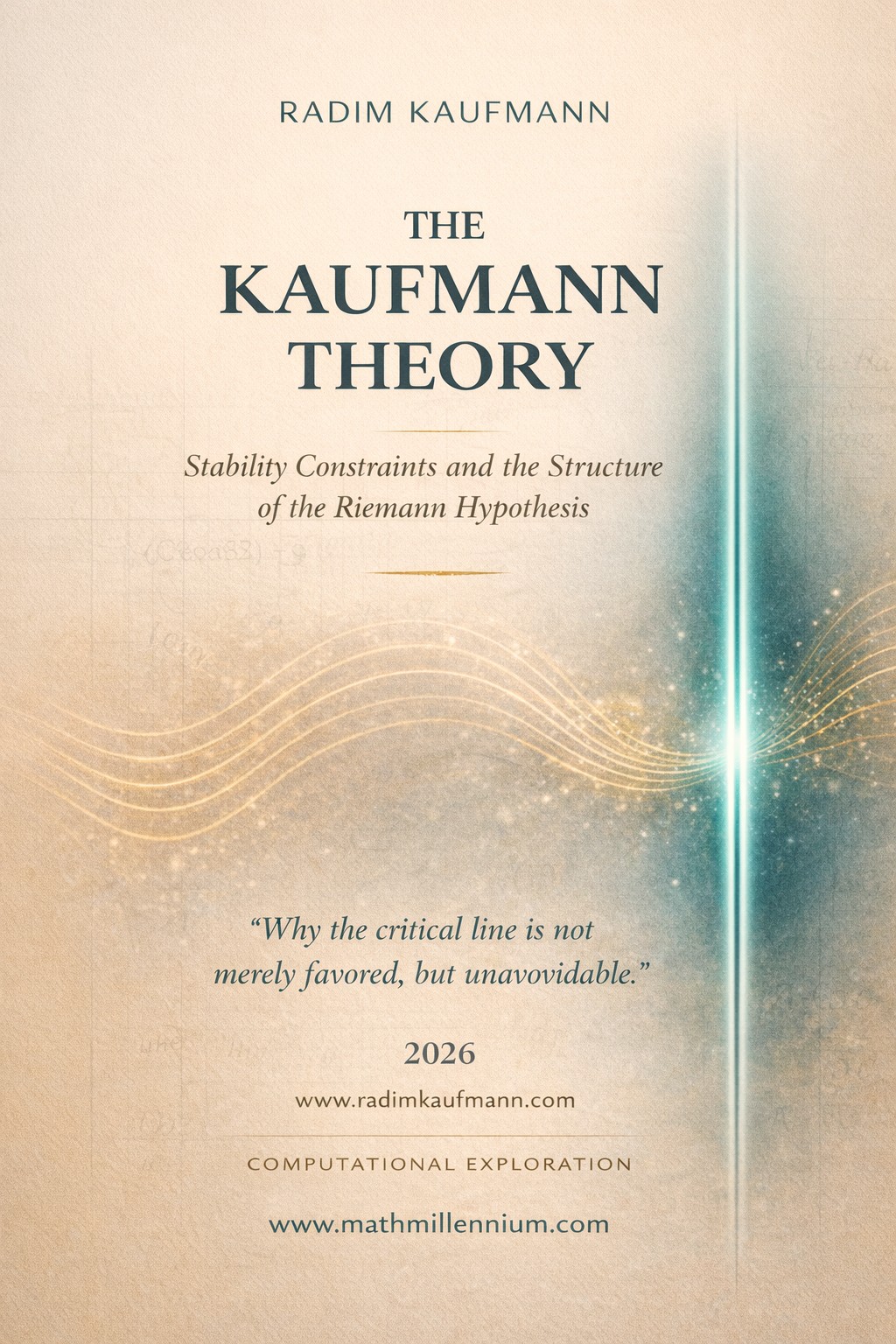
The Kaufmann Theory: Stability Constraints and the Structure of the Riemann Hypothesis
By Radim Kaufmann, 2026.